Overview
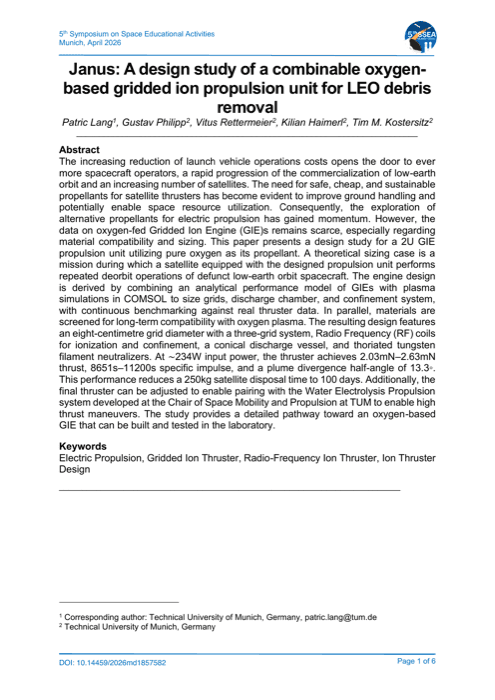
JANUS is a group design study of a 2U pure-oxygen gridded ion propulsion unit for LEO debris removal. The project addresses the lack of public data on oxygen-fed gridded ion engines, especially regarding sizing, plasma behavior, and material compatibility. The design uses RF ionization, a conical alumina discharge vessel, three ion-optics grids, and thoriated-tungsten filament neutralizers.
The resulting concept provides a detailed design pathway toward a laboratory-testable oxygen-based gridded ion engine, not a qualified flight system.
Motivation
LEO congestion is increasing, and active disposal methods require efficient, compact, and sustainable propulsion. Xenon and krypton are effective but expensive and increasingly supply-constrained. Oxygen is harder to use because oxygen plasma can accelerate erosion, but it is attractive for water-derived propulsion chains. Since water electrolysis produces hydrogen and oxygen, JANUS was designed as an oxygen-fed electric propulsion unit that could be paired with broader Water Electrolysis Propulsion architectures.
The JANUS paper uses the disposal of a 250 kg satellite as the public reference case and reports that the designed propulsion unit can reduce disposal time to approximately 100 days.
Design Method
The design was developed by coupling analytical GIE sizing with COMSOL simulations. A Python-based performance model provided first-order thrust, specific impulse, power, and vessel-sizing estimates. COMSOL plasma simulations were used to evaluate RF ionization and confinement. COMSOL ion-optics simulations optimized the three-grid system. A 3D particle-trajectory model then verified beam divergence, exit velocity, and the final vessel geometry.
The method was continuously benchmarked against literature and existing gridded ion thruster data where possible.
Technical Design
The final concept uses a conical Al2O3 discharge vessel, seven RF coil windings, a 1.8 MHz RF generator, an 8 cm grid diameter, titanium laboratory-test grids, and thoriated-tungsten filament neutralizers. The three-grid system consists of a screen grid, acceleration grid, and deceleration grid. The third grid reduces backstreaming and erosion risk.
- Pure oxygen propellant
- 2U propulsion-unit envelope
- 8 cm grid diameter
- Three-grid ion-optics system
- RF ionization and confinement
- 7 copper RF coil windings
- 150 W coil power
- 1.8 MHz RF frequency
- Conical Al2O3 discharge vessel
- 70 mm chamber length
- 29.745 degree maximum cone angle
- 4 mm vessel wall thickness
- Titanium grids for laboratory testing
- Thoriated-tungsten filament neutralizers
- Approximately 234 W total input power
Key Results
At approximately 234 W input power, the JANUS design targets 2.03 mN to 2.63 mN thrust, 8651 s to 11200 s specific impulse, and a plume divergence half-angle of 13.3 degrees. In the public reference case, this performance reduces the disposal time of a 250 kg satellite to approximately 100 days. These values are design estimates from analytical and numerical modeling, not experimental test results.
The final ion-optics system uses three flat grids: screen grid, acceleration grid, and deceleration grid. Titanium was selected for the laboratory grid material because of its oxygen compatibility and passivation behavior. For a later flight model, ceramic-coated molybdenum is identified as a possible development path, but it requires substantial experimental validation.
- Thrust: 2.03 mN to 2.63 mN
- Specific impulse: 8651 s to 11200 s
- Input power: approximately 234 W
- Plume divergence half-angle: 13.3 degrees
- Reference disposal case: reduction of a 250 kg satellite disposal time to approximately 100 days
Grid Design
The final ion-optics system uses three flat grids: screen grid, acceleration grid, and deceleration grid. The deceleration grid was included to reduce backstreaming and erosion risk.
- Grid thickness: 0.5 mm for all three grids
- Screen grid voltage: 1700 V
- Acceleration grid voltage: -300 V
- Deceleration grid voltage: 0 V
- Screen grid aperture radius: 1.7 mm
- Acceleration grid aperture radius: 1.3 mm
- Deceleration grid aperture radius: 1.7 mm
- Distance from screen to acceleration grid: 0.1 mm
- Distance from acceleration to deceleration grid: 0.5 mm
Neutralizer
The design uses thoriated-tungsten filament neutralizers. The neutralizer must emit enough electrons to compensate the positive ion beam and prevent spacecraft charging. The filament sizing uses the Richardson-Dushman equation and a Nottingham heat-loss formulation. The estimated lifetime should not be treated as validated because oxygen sputtering can become the dominant degradation mechanism.
- Operating temperature: approximately 2000 K
- Filament diameter: 125 um
- Filament length: 4.91 mm
- Source current: 2.220 A
- Source voltage: 1.120 V
- Power consumption: 1.12 W
- Estimated lifetime: approximately 2500 h under the simplified emission-based assumption
My Contribution
My contribution focused on the propellant assessment, preliminary grid design, and COMSOL-based ion-optics and particle-trajectory simulation. This was an individual contribution inside a group project, not a complete solo engine design.
- Evaluated hydrogen as a possible water-derived GIE propellant and supported the final oxygen baseline selection.
- Contributed to the preliminary ECSS Phase A design review of ion optics, ionization, confinement, discharge vessel, flow control, and neutralizer options.
- Performed literature-based preliminary grid sizing.
- Developed the 2D axisymmetric COMSOL ion-optics model for the three-grid system.
- Ran parameter sweeps for grid voltage, aperture radius, grid thickness, grid spacing, and center-to-center aperture spacing.
- Used beam divergence and particle velocity as the main optimization criteria for the grid geometry.
- Developed the 3D COMSOL particle-trajectory model used to verify vessel geometry and grid parameters.
- Imported the ion-density distribution from the 2D plasma simulation into the 3D particle model using Python preprocessing.
- Supported the final selection of the 70 mm vessel length and 29.745 degree cone half-angle.
- Contributed to the final technical report and JANUS publication material.
Limitations
The project remains a preliminary design study. Oxygen-fed gridded ion engines have limited public validation data, and no hardware test was performed in this project. The largest uncertainties are oxygen-plasma material compatibility, titanium-grid erosion, neutralizer lifetime, and the simplified plasma and particle assumptions used in the simulations. Experimental validation is required before any performance or lifetime claim can be treated as final.
- No experimental validation has been performed yet.
- Oxygen-fed GIE literature and comparison data are limited.
- Titanium grid lifetime in oxygen plasma beyond roughly 500 h is not publicly established.
- The plasma simulation requires validation against oxygen-fed RF thruster experiments.
- The performance model is simplified and does not fully capture deceleration-grid effects, plasma losses, conical vessel shape, ignition transients, instabilities, or grid-hole placement.
- The 2D grid model approximates the plasma potential with an anode boundary condition.
- Ions are initialized at rest in the grid simulations.
- The 3D model includes only ionized oxygen species and omits electrons, neutral atoms, RF coils, and magnetic fields.
- Neutralizer lifetime is highly uncertain in an oxygen environment.
- The CAD design is adapted for laboratory testing rather than flight qualification.
Next Steps
The logical next step is a laboratory test stand. Testing should validate oxygen plasma ignition, RF confinement, ion extraction, thrust, beam divergence, grid erosion, and neutralizer degradation. The resulting data should then be used to calibrate the analytical model and COMSOL simulations.
- Oxygen plasma ignition
- RF coupling and confinement
- Ion extraction
- Thrust and beam-current measurement
- Plume divergence characterization
- Grid erosion
- Neutralizer performance and lifetime
- Comparison of measured data with the analytical model and COMSOL simulations
Tools and Methods
- COMSOL Multiphysics
- Python
- MATLAB
- SolidWorks
- Analytical GIE performance modeling
- RF plasma simulation
- Ion-optics simulation
- 3D particle tracing
- Material compatibility screening
- Neutralizer sizing
- CAD demonstrator design
- Technical paper writing